
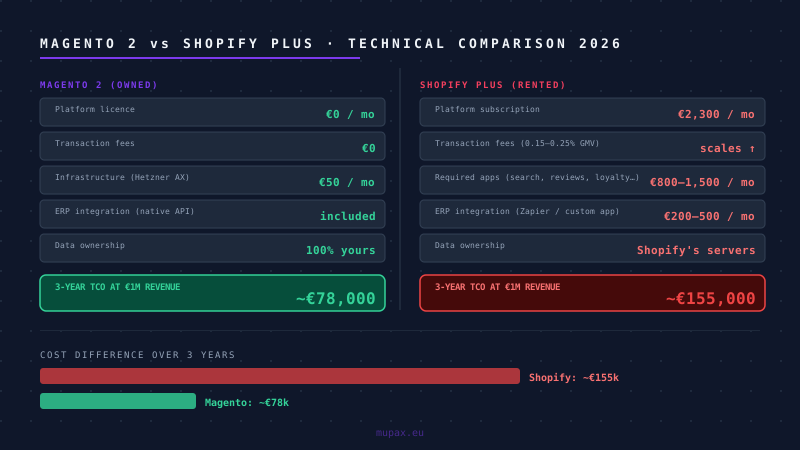
Magento and Shopify dominate the mid-market e-commerce discussion. Both power hundreds of thousands of stores. They solve the same surface-level problem - selling products online - but they make fundamentally different trade-offs around cost, control, and technical complexity.
The choice between them is not a question of which platform is "better". It is a question of which trade-offs your business can live with at your current scale and trajectory.
This comparison focuses on businesses doing between €500,000 and €5,000,000 in annual revenue. Below €500k, Shopify's advantages around simplicity and speed-to-market typically dominate. Above €5M, the TCO calculation rarely favours rented infrastructure.
Pricing: The Real Cost Over Three Years
Pricing comparisons between Shopify and Magento are often misleading because they compare licensing costs without total cost of ownership.
| Cost Item | Shopify Plus | Magento 2 Open Source |
|---|---|---|
| Platform licence | $2,300/month | €0 |
| Transaction fees | 0.15% - 0.30% per order | €0 |
| Third-party apps | $500 - $2,000/month | Variable (many free) |
| Hosting | Included | €40 - €200/month |
| Development (initial) | €5,000 - €15,000 | €15,000 - €40,000 |
| Ongoing maintenance | Low | Medium |
Three-year TCO at €1M annual revenue:
A Shopify Plus merchant doing €1M/year pays approximately $27,600/year in subscriptions, $1,500 - $3,000 in blended transaction fees, and $6,000 - $24,000 in app subscriptions. That is $35,000 - $55,000 per year in recurring platform costs before a single line of custom code is written.
A Magento Open Source merchant on equivalent infrastructure pays €480 - €2,400/year in hosting and has a larger upfront development investment - but the recurring platform cost is close to zero. The development premium (roughly €15,000 - €25,000 over Shopify's setup cost) is typically recovered within 18 months.
The crossover point is usually around €700,000 - €1,000,000 in annual revenue, depending on your app stack and transaction volume.
Performance: What the Numbers Say
Platform architecture determines your ceiling, not your current load.
Shopify is a managed SaaS: all merchants share underlying infrastructure. This removes operational complexity but also removes control. When Shopify's CDN or API layer is under load, your store is too. Response time SLAs are not published.
Magento 2 on dedicated infrastructure with Varnish and Redis delivers:
- Time to First Byte (TTFB): under 50ms for cached pages
- Largest Contentful Paint (LCP): under 1.8s on mobile with Hyvä frontend
- Cache hit rates above 95% for typical category/product page traffic
The Magento performance ceiling is high, but achieving it requires correct configuration. A default Magento installation without Varnish or Redis is slower than Shopify's managed infrastructure. The gap between default Magento and optimised Magento is larger than the gap between optimised Magento and Shopify.
| Metric | Shopify (typical) | Magento (default) | Magento (optimised) |
|---|---|---|---|
| TTFB | 200 - 400ms | 1,000 - 3,000ms | 30 - 80ms |
| Mobile LCP | 2.0 - 3.5s | 5 - 8s | 1.4 - 1.8s |
| Concurrent users | Managed | Depends on hardware | High (Varnish) |
Verdict: Shopify's managed performance floor is higher than Magento's unoptimised default. Magento's optimised performance ceiling is higher than Shopify's managed infrastructure. If you hire developers who know how to configure Magento, you will outperform Shopify on response time. If you do not, you will underperform it.
Customisation: Owning Your Stack vs. Renting Functionality
Shopify's customisation model works via themes and the app marketplace. You can customise the storefront extensively with Liquid templates and the Storefront API. You cannot modify the checkout for non-Plus merchants (2024 change). You cannot access the platform's database or core logic. The app ecosystem covers most common requirements - at a monthly subscription cost per app.
Magento's customisation model is based on dependency injection, plugins, and observers. Any part of the system can be overridden or extended at the code level. The checkout is fully customisable. Custom pricing rules, product types, and fulfilment logic can be built natively without third-party dependencies.
The practical consequence: a Magento store can implement business requirements that Shopify cannot accommodate at any subscription tier - complex B2B pricing tiers, ERP-integrated inventory reservation, custom tax calculation rules, multi-warehouse logic.
The trade-off: every customisation on Magento requires a developer. Shopify's app ecosystem means many requirements can be met without code changes.
Scalability: SKUs, Orders, and Integrations
| Dimension | Shopify | Magento |
|---|---|---|
| Product catalogue | ~10,000 variants (practical limit) | 100,000+ SKUs tested |
| Order volume | High (managed) | High (hardware-dependent) |
| B2B pricing | Available on Plus tier | Native, unlimited tiers |
| Multi-store | Multiple storefronts (paid) | Native multi-store |
| ERP integration | Via middleware or apps | Direct API or native |
| Multi-currency | Yes | Yes |
| Multi-language | English-only admin | Full multilingual |
For a single-language, single-currency DTC store with a catalogue under 5,000 SKUs, Shopify and Magento are roughly equivalent on scalability. The divergence appears at:
- B2B + DTC hybrid: Magento's native customer group pricing is significantly more flexible than Shopify's B2B tier.
- Large catalogues: Shopify's variant limit (100 options, 100 variants per product) forces workarounds for complex products. Magento has no practical limit.
- ERP integration: Magento's open database makes ERP integration more straightforward. Shopify requires webhooks to an external middleware layer for every inventory or order sync.
Data Ownership and Vendor Risk
This is the dimension least discussed and most consequential at scale.
On Shopify, your product data, customer data, and order history are held in Shopify's database. You can export it, but the format is proprietary and the export process is lossy (metafields, historical analytics, certain customisation data). If Shopify changes pricing, deprecates a feature you depend on, or is acquired, you have limited leverage.
On Magento, your data lives in your database. You can take a snapshot at any time. You can migrate to a different framework without a platform negotiation. The IP you build belongs to your company balance sheet.
This matters to investors and acquirers. A business running on owned infrastructure with exportable data has different risk characteristics than one that depends on a SaaS platform for its core operations.
Migration Between Platforms
Shopify to Magento migration is well-understood:
- Product, customer, and order history can be migrated via the Magento Data Migration Tool or custom scripts
- SEO preservation requires 301 redirecting every existing URL to its Magento equivalent (critical to do before DNS cutover)
- Typical timeline: 2-4 weeks for data migration on a mid-sized catalogue; 6-12 weeks for a full relaunch with custom features
- Organic rankings typically recover within 4-8 weeks of migration with correct redirect implementation
Magento to Shopify migration is possible but lossy: custom product types, complex pricing rules, and any Magento-specific customisations need to be rebuilt. Complex B2B implementations rarely map cleanly to Shopify's data model.
When to Choose Shopify
Shopify is the right choice when:
- You are launching: Speed to market is more valuable than platform control. A Shopify store can be live in days; a Magento build takes months.
- Your catalogue is small and standard: Under 1,000 SKUs, single language, single currency, no B2B requirements.
- You lack technical resources: Shopify's managed infrastructure means no DevOps overhead. Magento without a developer on call is a support risk.
- Revenue is under €500k/year: The subscription cost is justified by the operational simplicity.
When to Choose Magento
Magento is the right choice when:
- You are past €700k - €1M in annual revenue: The TCO crossover point where recurring fees exceed the cost of owned infrastructure.
- You have complex catalogue or pricing requirements: B2B pricing tiers, configurable products with many options, complex tax rules.
- You need deep ERP integration: Direct database access and a fully open API make integration faster and more reliable than Shopify's webhook-only model.
- You plan to sell internationally: Magento's native multi-store architecture handles multiple languages, currencies, and tax configurations in one installation.
- You value data ownership: Your customer and order data stay in your infrastructure.
We have built and migrated both Shopify and Magento stores. If you are evaluating a migration or a new build, talk to us - we can model the TCO for your specific revenue and catalogue before you commit.
Frequently Asked Questions
Is Magento better than Shopify for large stores?
For stores doing over €1M in annual revenue, Magento's total cost of ownership is typically lower than Shopify Plus, and its performance ceiling is higher when properly configured. Shopify Plus at that revenue level costs $35,000-$55,000 per year in platform fees alone. Magento's hosting and maintenance costs at the same scale are typically under €5,000 per year. The break-even on Magento's higher upfront development cost occurs at approximately 18 months.
What is the total cost of Shopify Plus vs Magento 2?
Shopify Plus starts at $2,300 per month for the subscription, plus 0.15-0.30% transaction fees and $500-$2,000 monthly in third-party apps for typical functionality. A merchant doing €1M annually pays approximately $40,000-$55,000 per year in platform costs. Magento 2 Open Source has no licensing cost; hosting on a dedicated server costs €40-€200 per month. The total three-year cost of ownership for a €1M revenue store is typically 3-5× higher on Shopify Plus than on a well-configured Magento installation.
Can you migrate from Shopify to Magento without losing SEO rankings?
Yes. A properly executed migration preserves organic rankings by mapping every Shopify URL to its equivalent Magento URL and implementing 301 redirects before DNS cutover. Product pages, collection pages, and blog posts all need explicit redirects. Migrations that skip this step see significant ranking drops. With correct redirect implementation, rankings typically recover within 4-8 weeks. Customer and order data can be migrated via Magento's Data Migration Tool or custom scripts.
Which is faster - Magento or Shopify?
An optimised Magento installation outperforms Shopify on server response time: Varnish serves cached pages in under 50ms, compared to Shopify's typical 200-400ms TTFB. On the frontend, Magento with Hyvä themes achieves mobile LCP under 1.8 seconds. The caveat is that default, unconfigured Magento is significantly slower than Shopify - the performance advantage requires proper setup. Shopify's managed infrastructure provides a higher performance floor; Magento's optimised configuration provides a higher ceiling.
When is Shopify the better choice over Magento?
Shopify is the better choice for new stores under €500,000 in annual revenue that need to launch quickly, have a standard single-language catalogue, and lack dedicated technical resources. The operational simplicity of managed infrastructure justifies the subscription cost at lower revenue levels. For stores with complex B2B pricing, large catalogues over 5,000 SKUs, or ERP integration requirements, the trade-offs typically shift toward Magento once revenue exceeds €700,000 per year.