
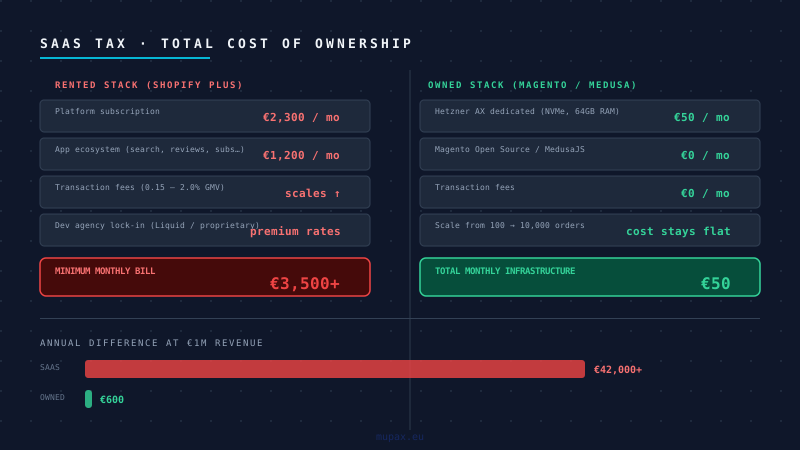
There is a seduction in modern SaaS platforms like Shopify or BigCommerce. They promise you a store in minutes. No servers to manage, no patches to install. Just sign up and sell.
For a startup doing €10k/month, this is a great deal. For a scaling business doing €1M/year, it is a financial trap.
The SaaS tax is the compounding cost of a subscription platform where fees scale with your revenue rather than your resource usage. As sales grow, you transfer margin to the platform vendor instead of reinvesting it in your business.
We call this the SaaS Tax. It is the exponential cost of renting your infrastructure instead of owning it.
The "Success Tax" Mathematical Problem
The fundamental flaw in the SaaS business model (for you, not for them) is that costs scale with revenue, not with resource usage.
If you run a dedicated server on Hetzner, the CPU doesn't care if you sell a €10 t-shirt or a €1000 laptop. The server cost is fixed (~€40/month).
If you run on Shopify Plus, you pay a "Success Tax" on every transaction.
- Subscription: ~$2,300 / month (Plus plan) - Shopify's published pricing
- Transaction Fees: 0.15% - 2.0% (depending on gateway)
- App Ecosystem: ~$500 - $2,000 / month
The App Trap
The core platform is intentionally bare-bones. Want advanced search? $299/mo. Want reviews? $199/mo. Want subscriptions? $300/mo. You aren't buying software; you are subscribing to 15 different startups, each taking a slice of your margin.
The Alternative: The "Owned" Stack
Compare this to a modern, self-hosted stack engineered by Mupax:
- Core: Magento 2 (Open Source) or MedusaJS.
- Frontend: Next.js or Hyvä (Ultra-fast).
- Infrastructure: Hetzner Dedicated AX Series (NVMe, 64GB RAM).
Total Monthly Fixed Cost: ~€40 - €60.
Whether you do 100 orders or 10,000 orders, your infrastructure cost remains virtually flat. You pay for computing power, not for the privilege of selling your own products.
"But what about maintenance?"
This is the most common counter-argument. "Servers require maintenance!"
Yes, they do. But let's look at the numbers.
- Option A (SaaS): You pay €30,000+ per year in fees + transaction costs. You have zero control over the roadmap. If they raise prices (which they do), you pay.
- Option B (Owned): You pay €600/year in infrastructure. You invest the saved €29,400 into your own development team or marketing.
Ownership is an Asset
When you build on SaaS, you are a tenant renovating a rented apartment. You can paint the walls, but you can't knock them down. And if the landlord evicts you, you leave with nothing.
When you build your own stack, you are building Intellectual Property. You own the data. You own the customer relationship. You own the code.
The maths gets uncomfortable quickly once you look at it. You are already paying for your own growth to benefit someone else's revenue multiple. That is a legitimate choice - but it helps to know you are making it.
Frequently Asked Questions
What is the SaaS tax in e-commerce?
The SaaS tax is the compounding cost of renting a subscription-based e-commerce platform where fees scale with revenue rather than resource usage. As your sales grow, you pay more in transaction fees, app subscriptions, and platform charges - transferring margin to the platform vendor rather than reinvesting it in your business.
How much does Shopify Plus cost per month?
Shopify Plus starts at $2,300 per month as of 2026. On top of the subscription, merchants pay transaction fees of 0.15-2.0% per sale and typically $500-$2,000 monthly for third-party apps the base platform does not include - advanced search, reviews, subscriptions, and loyalty programmes each carry a separate monthly fee.
At what revenue point does Shopify become too expensive?
The crossover is typically around €500,000-€1,000,000 in annual revenue. Below that, the speed and simplicity of managed infrastructure outweighs the fees. Above it, transaction costs and app subscriptions usually exceed the development and hosting cost of an owned platform. At €1M annual revenue, 1% in blended transaction fees is €10,000 per year - before app costs.
What is the alternative to Shopify Plus for scaling e-commerce?
The main alternatives are Magento 2 Open Source, WooCommerce with managed hosting, and MedusaJS. Magento 2 handles high order volume and complex catalogue requirements well. Infrastructure on a dedicated Hetzner server costs €40-60 per month regardless of order volume - the same whether you process 100 orders or 10,000.
Can you migrate from Shopify to Magento 2 without losing SEO rankings?
Yes. A proper migration preserves all product URLs, customer data, and order history. The critical step is mapping every Shopify URL to its Magento equivalent and implementing 301 redirects before the DNS switch. Done correctly, organic rankings recover within 2-4 weeks of migration.