
The software industry runs on a specific kind of fuel: Confidence.
Walk into most agency pitches, and you will hear: "We scale infinitely", "We utilize bleeding-edge AI", "We are future-proof". It is a comforting wall of noise. For a non-technical founder, hiring a team that claims to have "no limitations" feels safe.
But there is a specific type of founder who doesn't buy it. These are the people who have already been burned. They have already paid for the massive rewrite that went 200% over budget. They know that "infinite scale" usually means "infinite invoice".
These founders stop asking, "Can you build this?". They start asking the much harder question: "Are we about to make a huge mistake?".
The "Google Scale" Trap
We constantly see teams of four developers obsessing over architectures designed for Netflix. They are preparing for a future that hasn't happened yet, at the expense of the present.
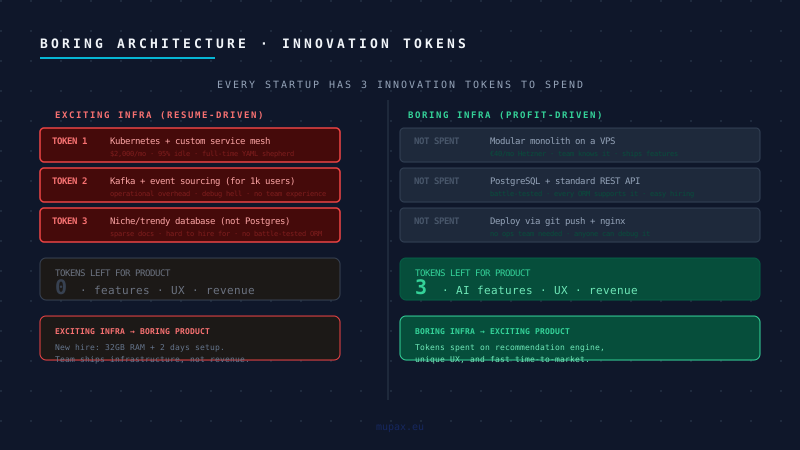
The Scenario: A startup has 1,000 daily users. They decide to adopt a full microservices architecture on Kubernetes because they want to be "ready for millions".
The Reality:
- The Bill: They are paying $2,000/month for AWS resources that sit 95% idle.
- The Friction: Instead of shipping features, their best developer is now a full-time "YAML Shepherd", debugging Terraform scripts and networking issues.
- The Onboarding: To run the app locally, a new hire needs 32GB of RAM and two days of setup time.
This isn't "future-proofing". This is Resume-Driven Development. Developers often build what looks good on their CV, not what is good for the business.
The correct solution is often boring. It looks like a modular monolith. It runs on a boring VPS. It uses Postgres. It doesn't use Kafka just because it's trendy. Two years later, that boring solution is still running, it's cheap and most importantly - it didn't kill the company.
The Theory of "Innovation Tokens"
Why fight so hard for "boring" tech? It comes down to basic economics.
Every company has a limited budget for complexity. Let’s call these "Innovation Tokens". A startup only gets about three tokens to spend on "weird" or "new" technology.
If you spend your tokens on infrastructure (e.g., building a custom service mesh or using a niche database), you have no tokens left for your product.
Smart teams choose boring architecture (Postgres, standard REST APIs, Monoliths) so that they can hoard those tokens for the things that actually generate revenue: unique algorithms, recommendation engines, or user experience. Spend your complexity budget on infrastructure and you have none left for the product.
Surgery vs. The "Big Bang" Rewrite
One of the most dangerous phrases in software is: "Let's just rewrite it properly from scratch".
Rewrites are seductive. They promise a fresh start without the baggage of legacy code. But they almost always fail. Why? Because the market doesn't pause while you code.
- Month 1-3: The new "V2" architecture is clean and fast. Everyone is happy.
- Month 6: The business needs a new payment method today. It has to be added to the old "V1" app because V2 isn't ready.
- Month 12: V2 is still "90% done". But V1 has evolved. The team is now chasing a moving target. The rewrite is quietly abandoned.
The Alternative: The Surgical Fix. The pragmatic move is surgical intervention. Identify the single bottleneck that is actually hurting the business and fix only that.
Example: Product search is slow.
- The "Rewrite" approach: "Rebuild the entire platform in Go". (Cost: High, Time: 9 months).
- The Surgical approach: Keep the messy monolith. Spin up a tiny Elasticsearch instance just for search. Route search traffic there. (Cost: Low, Time: 3 weeks).
The rest of the code stays "ugly". But the user is happy, and the business saved six months of runway. That is engineering ROI.
The Dirty Secret of "Vendor Lock-In"
There is a darker reason why the industry pushes for complexity: Job Security.
If an outsourced team builds a Rube Goldberg machine of 20 microservices, custom service meshes and undocumented event buses, you cannot fire them. You are terrified that if they leave, the system stops working. You become a hostage to your own architecture.
The antidote is to demand systems so boring and standard that you could technically hand the project to a mid-level freelancer tomorrow.
Great architecture is replaceable by design. This sounds counter-intuitive, but it is the ultimate filter. A system that is easy to hand over is a system that is robust, documented and clean. It proves that the architecture serves the business, not the architects.
The Hiring Advantage
Finally, there is the human cost.
If a system is built on "hype" technology, the hiring pool is limited to a tiny circle of expensive specialists. The company becomes dependent on "Rockstars" who know they are irreplaceable.
If a system is built on "boring" technology (standard languages, standard databases), the talent pool is massive. You can hire for problem-solving skills, not just familiarity with an obscure framework. Boring tech creates resilient teams. Hype tech creates fragile ones - and the people who built it usually know it.
Why This Scares People
So, why does "boring" scare people? Why do founders get nervous when an architect proposes a monolith?
It's FOMO (Fear Of Missing Out). They read TechCrunch. They see what Google and Netflix are doing. They fear that if they don't use the "modern stack", they will become obsolete.
But the truth is: Google is not your competition. Complexity is your competition.
There are no magic pills against business complexity. There is only the clarity to build what matters and the discipline to ignore the rest.
If you have been sold complexity you do not need, or want a second opinion on your architecture before the next sprint, talk to us.
Frequently Asked Questions
What is "boring architecture" in software development?
Boring architecture is the deliberate choice of proven, widely-understood technology - PostgreSQL, REST APIs, a modular monolith - over newer or more fashionable alternatives. It is boring because the problems are known and the solutions are documented. Teams that choose boring architecture spend their complexity budget on the product, not on infrastructure. The systems it produces are cheaper to operate, easier to hire for, and more straightforward to hand over.
What are "Innovation Tokens" in software engineering?
Innovation Tokens is a mental model for a company's finite budget for complexity. The premise: every team gets roughly three tokens to spend on non-standard technology choices. Spend tokens on infrastructure (a custom service mesh, a niche database, a distributed monorepo) and you have none left for the product features that generate revenue. Spend them on the product (a novel recommendation algorithm, a differentiated UX, a proprietary data model) and the infrastructure stays simple enough to maintain and hire for.
Why is a modular monolith better than microservices for small teams?
A modular monolith has lower operational overhead (one deployment, one database, one log stream), simpler local development (no service discovery, no network stubs), and faster debugging (Ctrl+Click reaches the actual code, not an API contract). Microservices solve an organisational problem - multiple large teams stepping on each other - that a team of five does not have. For small teams, the distributed system complexity typically costs more in developer time than it saves.
What is resume-driven development?
Resume-driven development is the pattern where engineers adopt complex or fashionable technology because it improves their CV rather than because it serves the business. A team of four adopting Kubernetes for 1,000 daily users is a common example: the system is idle 95% of the time, but "Kubernetes" appears on every team member's resume. The organisational cost is a full-time DevOps burden, a 32GB-RAM onboarding requirement for new hires, and a slower product velocity.
When should a small company adopt microservices?
When one of three specific conditions is true: a function needs to scale or deploy independently at a fundamentally different rate from the rest of the application; a security boundary (PCI scope, for example) requires physical isolation; or separate large teams are creating genuine deployment conflicts daily. If none of these apply, a modular monolith with strict internal boundaries delivers the same architectural discipline without the distributed systems overhead.